Industry News
Market Scale of China's Edible Fungus Industry
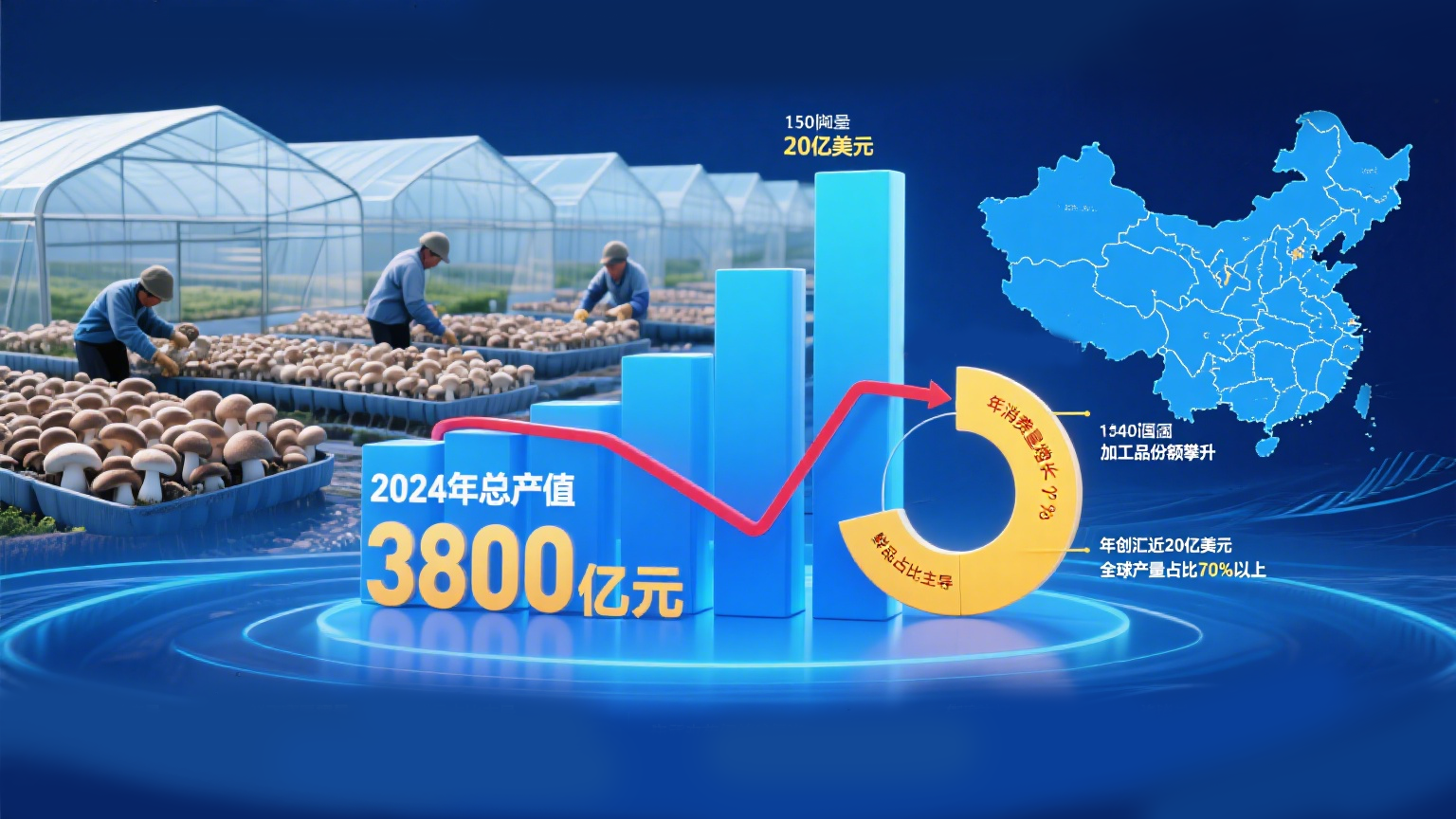
China's edible fungus industry has achieved remarkable development over the past few decades, becoming the world's largest producer, consumer, and exporter of edible fungi. In recent years, the industry's output value has steadily increased, surpassing 380 billion yuan in 2024, highlighting its significant role in the national economy.
From a production perspective, China's edible fungus output has accounted for over 70% of global production for many consecutive years, reaching 43.2566 million tons in 2023. This massive output not only meets robust domestic demand but is also exported to more than 150 countries and regions worldwide, generating nearly $2 billion in annual foreign exchange earnings. The sustained growth in production stems from the steady expansion of cultivation areas, with regions across the country actively developing edible fungus farming tailored to local conditions. Additionally, innovations and optimizations in cultivation technology have significantly improved yield per unit area.
In the consumer market, as living standards rise and health awareness grows, edible fungi are increasingly favored for their rich nutritional value and unique flavors, with annual consumption growing at a rate of 7%. Sales channels for edible fungi and their processed products have broadened from traditional farmers' markets to large chain supermarkets and e-commerce platforms, continuously expanding market coverage.
From a segmented market perspective, fresh edible fungi dominate, meeting daily dietary needs with their freshness and superior taste, accounting for a significant share of sales. Meanwhile, processed products such as canned, dried, snack, and seasoning items are gaining market share year by year due to their advantages in preservation, portability, and convenience, showing promising growth trends.
Development Trends of China's Edible Fungus Industry
Technology-Driven Industrial Upgrading
1.
Widespread Adoption of Smart Cultivation: Under the wave of technological innovation, the edible fungus industry is rapidly advancing toward intelligence and precision. Cutting-edge technologies like IoT, big data, and AI are deeply integrated into cultivation, enabling precise control of growing environments. Sensors deployed in cultivation bases collect real-time data on temperature, humidity, light, and CO₂ levels, with smart control systems automatically adjusting conditions to ensure optimal growth, improving both efficiency and product quality. For example, some advanced industrialized producers have automated processes from mixing substrates to bagging, sterilization, inoculation, and fruiting, reducing labor costs while enhancing stability and controllability.
2.
Breakthroughs in Strain Innovation: Strains are the core of the edible fungus industry, and their quality directly impacts the sector's success. In the future, research institutions and enterprises will increase investment in strain R&D, leveraging rich genetic resources through hybridization and gene editing to develop high-yield, high-quality, and stress-resistant varieties. Accelerating strain cultivation cycles will meet market demand for diverse, high-quality strains, driving sustainable development. For instance, Fujian Academy of Agricultural Sciences successfully bred a new button mushroom strain suitable for industrialized cultivation, breaking foreign monopolies and injecting new momentum into China's button mushroom industry.
3.
Deepening Green Cultivation: Amid growing emphasis on environmental protection and sustainability, green cultivation will become mainstream. Agricultural waste like crop straw and livestock manure will be widely used as substrates, enabling resource recycling while reducing costs and pollution. Green pest control techniques will replace chemical pesticides, ensuring product safety and competitiveness. Ecological models like "rice-mushroom rotation" and "forest-fungus intercropping" are being explored, improving land use efficiency while delivering economic and ecological benefits.
|
County/City
|
Mushroom Types
|
Cultivation Area Details
|
|
Gutian County, Fujian
|
Over 30 types, including tremella
|
Gutian is China's largest tremella production base, with 396,000 tons in 2023, accounting for over 90% of national output. While exact area data is unavailable, over 80% of rural households engage in edible fungus production, indicating vast scale. Tremella cultivation dominates the local industry, supporting a total industrial chain value exceeding 10 billion yuan.
|
|
Sui County, Hubei
|
Shiitake mushrooms
|
Annual production of nearly 3.3 billion bags, with over 120 specialized villages. The scale reflects extensive cultivation, making it one of China's largest shiitake production bases.
|
|
Changshan County, Zhejiang
|
Lion's mane, enoki, etc.
|
In 1986, Changshan produced 750 tons of lion's mane, ranking first globally. By 1988, enoki output reached 1,542 tons, making it China's largest enoki producer. Continued development suggests sustained scale.
|
|
Xiayi County, Henan
|
Button mushrooms, straw mushrooms
|
Over 19,000 standardized mushroom houses covering 9.5 million m², forming a multi-variety hub. It is the largest button mushroom base in eastern Henan and the province.
|
|
Lingshou County, Hebei
|
Enoki, white elf mushrooms
|
Nearly 16,000 farming households and 6 million m² of cultivation, making it a major northern production and distribution center.
|
|
Caiyang Town, Dayi County, Sichuan
|
Field mushrooms
|
In 2003, cultivation reached 4,000 mu (667 acres), totaling 8,400 mu over four years. Known as "China's Edible Fungus Hometown."
|
|
Pingquan County, Hebei
|
Shiitake, nameko, etc. (30+ varieties)
|
Transitioning from scattered backyard production to outdoor, intensive cultivation. All 19 townships engage in production, indicating large-scale operations.
|
|
Songxi County, Fujian
|
Various edible fungi
|
A major production county with favorable climate, though exact area data is unavailable.
|
|
Lanling County, Shandong
|
Various edible fungi
|
Cultivation spans all 16 townships, reflecting large-scale industrialization.
|
|
Zunhua City, Hebei
|
Shiitake mushrooms
|
A 32,000-mu modern agricultural park with 6,000+ standard sheds, making it northern China's largest production base.
|
|
Guangchang County, Jiangxi
|
Tea tree mushrooms, etc.
|
600 mu of forest-based cultivation. Guangchang pioneered artificial tea tree mushroom cultivation, with 203,000 mu of forest-based farming overall.
|
|
Xixia County, Henan
|
Shiitake mushrooms
|
Stable annual production of 300 million bags, making it a leading national production and export base.
|
|
Lushi County, Henan
|
Shiitake mushrooms
|
Over 7,000 standardized sheds and 360 million bags annually, earning the title "Shiitake Capital."
|
|
Shangdian Town, Linqing, Shandong
|
Oyster mushrooms
|
150 sheds (500 mu total), including 128 oyster mushroom sheds (300+ mu), making it Shandong's largest single-site base.
|
Diversified Industrial Integration
1.
Integration with the Health Industry: Edible fungi, rich in protein, polysaccharides, fiber, vitamins, and minerals, are increasingly prominent in health products. Beyond traditional consumption, they are used in functional foods, supplements, and medicines. For example, bioactive polysaccharides from fungi enhance immunity and combat tumors, driving supplement R&D. Fermented fungal beverages also gain popularity for their unique flavors and health benefits, expanding market potential and value.
2.
Integration with Cultural Tourism: Regions are blending edible fungi with rural tourism and cultural experiences, creating themed attractions. Visitors can tour farms, learn about cultivation, participate in harvesting, enjoy fungal cuisine, and purchase specialty products. Gutian County's fungal culture tourism area attracts many visitors, boosting local tourism and brand recognition while fostering industrial synergy.
3.
Integration with E-Commerce: The internet has opened new sales channels, with e-commerce platforms enabling producers to reach global markets directly. Livestreaming and short videos showcase cultivation processes and product features, building consumer trust and driving sales. Remote areas have leveraged e-commerce to "make small mushrooms conquer big markets," promoting local specialties and increasing farmer incomes.
Usage Scenarios
•
Daily Cooking: Widely used in home and restaurant dishes—stir-fried, stewed, boiled, or grilled (e.g., shiitake stir-fry, chicken-mushroom stew, mushroom soup, grilled matsutake).
•
Food Industry: Used in prepared dishes, snacks, and seasonings (e.g., mushroom-flavored seasonings, mushroom snacks).
•
Health Sector: Valued for nutrients and bioactive compounds, used in supplements, functional foods, and medicines (e.g., shiitake polysaccharides for immunity-boosting products).
Primary Processing Types
•
Drying: Sun-dried or mechanically dehydrated to <13% moisture for long-term storage (e.g., dried shiitake, wood ear, tremella).
•
Salting: Pre-cooked and soaked in brine for preservation (e.g., salted oyster mushrooms, enoki).
•
Sugaring: Pre-cooked and sweetened into ready-to-eat products (e.g., candied oyster mushrooms, lion's mane preserves).
Deep Processing Types
•
Health Foods: Products like mushroom meal replacement powder and protein bars for health-conscious consumers.
•
Functional Beverages: Extracts used in drinks (e.g., reishi coffee, cordyceps energy drinks).
•
Cosmetics: Polysaccharides and antioxidants for skincare (e.g., tremella masks, shiitake serums).
•
Pharmaceuticals: Active ingredients for medicines (e.g., shiitake polysaccharide injections for cancer therapy).
Health Applications
•
Supplements: Capsules, tablets, and oral liquids (e.g., reishi spore capsules, cordyceps tonics) for immunity and body regulation.
•
Functional Foods: Tailored products like lion's mane biscuits for diabetics (low-sugar, blood sugar-regulating).
•
Nutraceuticals: Immunity-boosting supplements (e.g., shiitake polysaccharide extracts).
Innovative Food Applications
•
Snacks: Crispy mushroom chips and flavored tofu, popular for texture and taste.
•
Prepared Dishes: Convenient mushroom-based meals (e.g., mushroom-braised pork).
•
Beverages: Fermented drinks (e.g., shiitake vinegar) combining nutrition and flavor.
Optimizing Industrial Layout and Structure
1.
Regional Layout Optimization: Previously uneven development is being addressed by leveraging local resources, climate, and demand. Coastal areas focus on high-tech, high-value production and trade, while central and western regions emphasize large-scale, specialized bases. For example, coastal firms are relocating production inland to cut costs and boost local industries.
2.
Product Structure Optimization: Moving beyond fresh and primary processed products, the industry is diversifying into rare varieties (e.g., morels, matsutake, truffles) and value-added items like snacks, seasonings, and functional foods. Mushroom snacks, for instance, are gaining popularity among young consumers.
Future Outlook: China's edible fungus industry is entering a golden era. With technological innovation, industrial integration, and optimized layouts, this "small industry" will unleash greater potential. Meeting domestic demand while expanding globally, the sector will shift from scale-driven to quality-driven growth, supporting agricultural modernization and rural revitalization through green, smart, and internationalized development.
创新博览会LOGO.png)
.webp)


创新博览会LOGO-white.png)